

When you’re in your garden or out and about from early spring into summer, you may hear a “chiff-chaff-chiff-chiff” call. This sound comes from a Chiffchaff, a bird with an onomatopoeic name, derived from this distinctive breeding call.
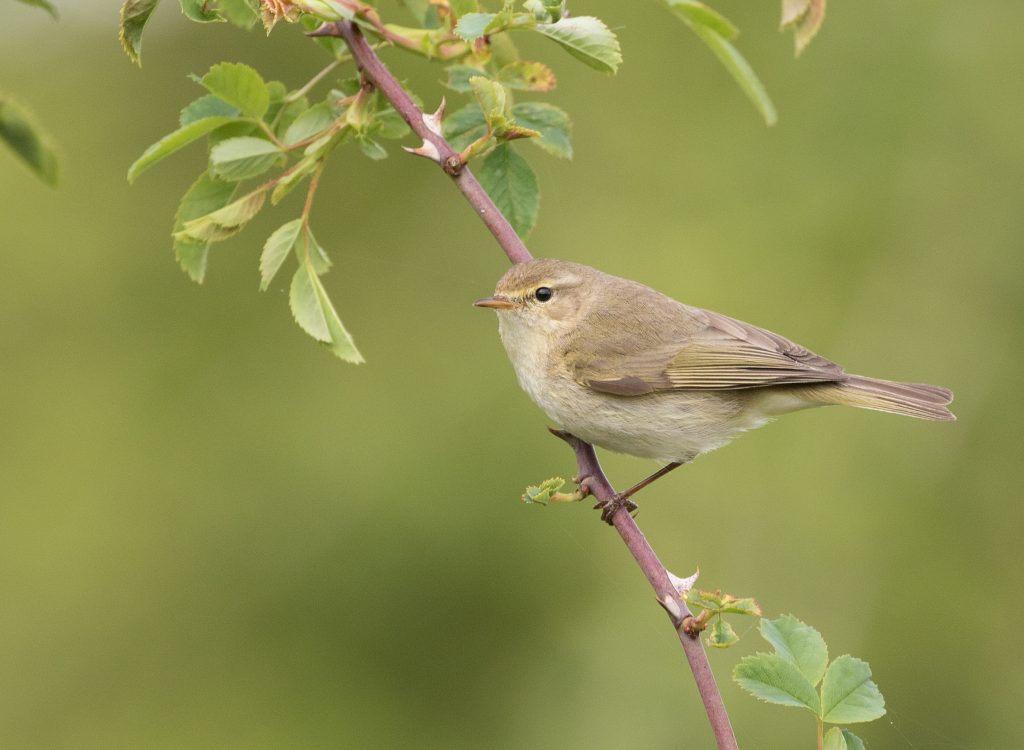
Chiffchaffs are small warblers which are frequently heard but less easy to see. They have yellow-olive plumage, a dark eye and pale eyebrow stripe. Their bill is dark and they generally have dark-coloured legs. Leg colour can be a useful feature for distinguishing Chiffchaff from the similar-looking Willow Warbler (which has paler pinkish legs), though this identification feature isn’t foolproof.
The Chiffchaff breeding season starts in mid-April, when females lay five or six eggs, which are white and speckled with brown. The nest, which is a loose ball of woven grasses and other material, is usually built between 10cm and 30cm above the ground in dense foliage such as brambles, nettles or dead bracken. Chiffchaffs can produce two broods each year.
They are insectivorous and can usually be found hunting for insects on the ends of branches in the canopy. While generally associated with woodland and scrub, Chiffchaffs may also be found in gardens. The BTO’s Garden BirdWatch survey asks volunteers to monitor birds that visit their gardens, and whilst Chiffchaffs will commonly sing from within your garden area, they typically nest in wilder spaces nearby.
This species breeds across Britain and Ireland and is found in most areas apart from on very high ground. Interestingly, Chiffchaffs have been expanding their breeding range northwards across Scotland, something that has been associated with climate change.
There are also an increasing number of Chiffchaffs now overwintering in the UK, which contributes to them being one of our earliest spring songsters, with their call resonating from woodland and scrub habitats from mid-February onwards. Other individuals spend the non-breeding season in southern Europe and northern Africa, returning to more northerly latitudes to breed, including here in Thetford.
Recording birds such as Chiffchaffs in your garden as part of BTO’s Garden BirdWatch survey helps us understand how and why populations of garden birds and other wildlife are changing, and how we can help them. You can help by keeping a simple list and telling us which species visit each week, helping us learn about how wildlife uses the food, shelter and other resources in our gardens.
Sign up to take part at www.bto.org/GBW/Join
Words by Susan Jones, BTO