

With bird populations in decline, adding a nest box to your garden can make a real difference. The British Trust for Ornithology shares practical advice on how to choose and position the right box for local species.
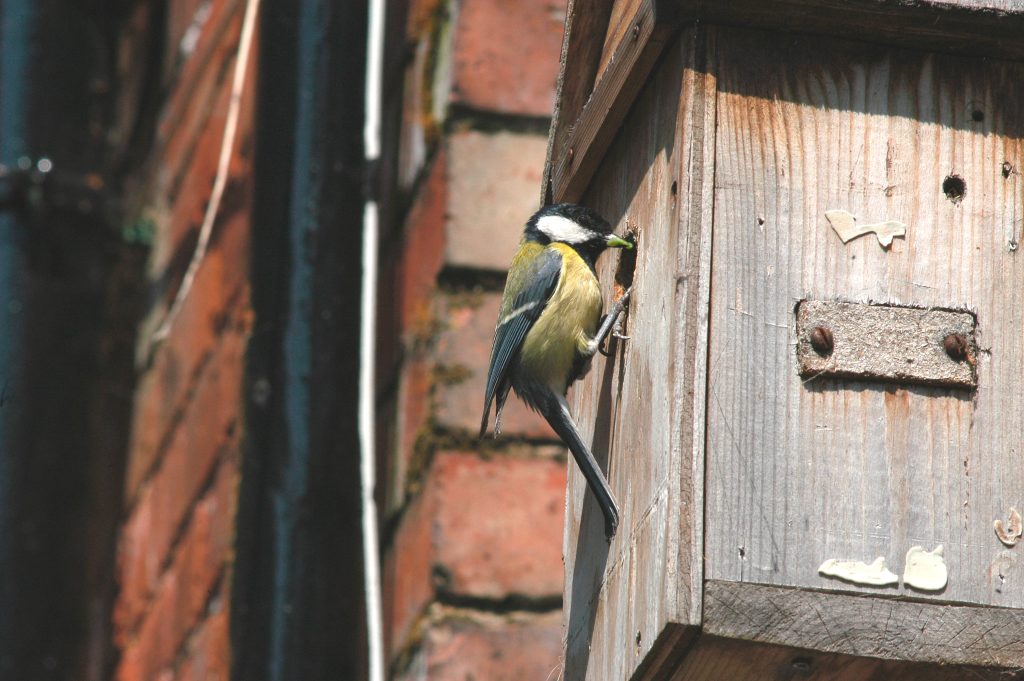
Great Tit in nest box by David Waistell / BTO
Some of our best known birds have shown alarming declines in recent years; we have lost almost three quarters of our breeding Starlings and over a third of our House Sparrows, and whilst the drivers behind these declines remain unclear, loss of nesting space is likely to be a contributor. Fortunately both of these species readily take to nest boxes. So, what do they require from a nest box? Importantly, they need a nest box with the right size entrance hole – 45mm for the Starling and 32mm for the House Sparrow.
Location is of importance, but even the smallest urban garden can have space for a nest box. House Sparrows and Starlings often nest under our eaves and a nest box located in this position on the wall of the house can provide the safe space they need. However, there are a few things to consider when siting a nest box. Try to avoid putting the box in a location where it will be in direct sunlight for any length of time; this will avoid overheating. Consideration should also be given to access by predators – think cats! – and this should cover any eventualities. If a box is difficult for a cat to access, then it will be out of the reach of most predators.
There are lots of different birds that will use nest boxes, the most familiar probably being Blue and Great Tits; these both use what we call small-hole type nest boxes. Again hole-size is important, 25mm for Blue Tit and 28mm for Great. The larger hole won’t exclude Blue Tits and they may well use a box designed with a larger species in mind. However, the small hole will exclude larger birds. So you could put up a nest box designed for Starlings and find it is occupied by Great Tits.
Not all species use the hole-type nest box. Some use an open-fronted box, a box that looks like a small letter box. Robins will use these along with the much rarer Spotted Flycatcher, a summer visitor that spends the winter months south of the Sahara. These boxes are often more attractive to the birds if they are sited within a small amount of cover; a creeper or ivy covered wall will do the trick. If you have lots of space, there are birds that use much larger boxes. Barn and Tawny Owls often find nest boxes hard to resist, and birds such as Jackdaw and Stock Dove will use the larger boxes too.
The British Trust for Ornithology have produced a new nest box guide, full of information on the different types of nest box, where to site them, plans on how to make them, and guidelines on how to make your box count should it be occupied. For more information on the new guide, visit the BTO website:
https://www.bto.org/sites/default/files/bto-nest-boxes-essential-guide.pdf
Jenny Donelan, British Trust for Ornithology