

Nigel Tooth from the West Norfolk Aviation Society recaps a talk by Barry Raphael, who shared his insider knowledge of the iconic Handley Page Victor bomber.
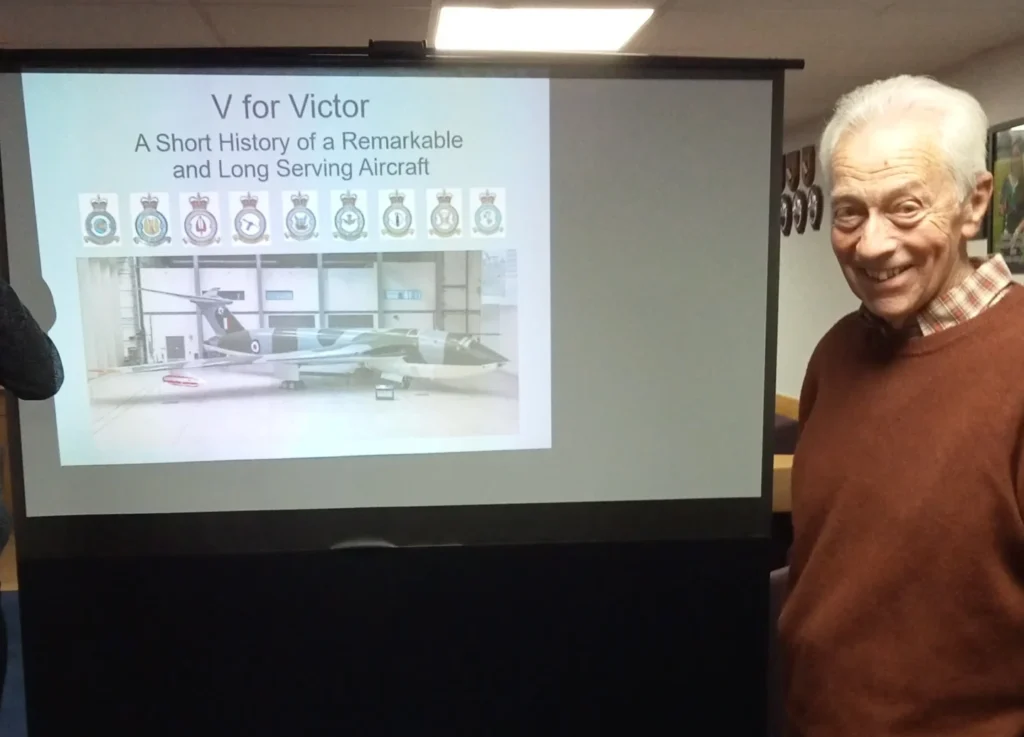
“‘V for Victor’ was the title of this month’s talk; delivered by Ickburgh man, Barry Raphael, virtuoso on the subject of the V bombers and ex-crew member of 55 squadron; he was too modest to say whether or not he was captain. On a previous occasion he has briefed us about his time spent with the Valiant during the Suez crisis but on this occasion he presented to us a masterful account of his involvement with the Handley Page Victor, an aeroplane that has the distinction of being the longest serving military aircraft on record; over 50 years. Barry’s account was so detailed that one could easily have believed that he might have had a hand in the design of the aircraft itself.
After 1947 the war ministry decided that future peacetime stability should depend on a nuclear deterrent. Adolph Hitler’s regime, before this time, had been preoccupied with ground based missiles. For the best security it was decided that future tactics should involve the delivery of nuclear weapons by air. The Victor was chosen to be the best provider for this purpose and, the bombs would be either Skybolt or Blue Steel.
Frederick Handley Page had first found fame in 1911 with his legendary ‘stick and string’ Yellow Peril monoplane, characterised by a convex leading edge to the wings (re: 1965 film ‘Those Magnificent Men in Their Flying Machines). Barry made a tongue in cheek comparison with this and the leading edge of the Victor wings: in this case, the curve was concaved but, for a very good reason: They were described as ‘crescent’ and constructed in three separate sections each one having its own effect on the aerodynamics of the aircraft. Its development was an on-going scenario: the empennage, rear section, also came under scrutiny; the dihedral of the “T” tail plane was critical for optimum stability as was the design of the rudder; an extra bolt in a pintle overcame one problem. Barry explained that on-going modifications were always necessary to overcome the price that was being paid for the loss of the lives of many test pilots; in the 1950s this amounted to about one a week.
The assembly of the Victor began in ‘Fred’s Shed’ at Radlett. This was deemed too small and construction was completed at Boscombe Down over 100 miles away. For security reasons it was wrapped up and transported by road disguised as a boat. Details in the cock-pit design included the use of retractable instrument panels to optimise space and, a livery of white to minimise the glare from bomb blast. Flight tests included controlled loops and rolls. The aeroplane also proved its versatility when its presence was felt in the Falklands war as an aid to reconnaissance and refuelling. And, Barry explained that on one of the trials of his baby, the navigator, facing rearwards, gained the distinction of being the only person in the world to have broken the sound barrier flying backwards.
At the end of the evening the stand-in chairman, Commander Allen, thanked the Bowls Club executive committee for their hospitality, tendered apologies from absentees and recruited a first-time guest-member, Bob Archer, to provide next month’s talk on the subject of ’75 Years of Aviation at Mildenhall.’”
Nigel Tooth
Check out: www.westnorfolkaviationsociety.org.uk


