

Nick Moran from the British Trust for Ornithology talks about the epic journeys of Thetford’s wintering birds, and the best spots to see them.
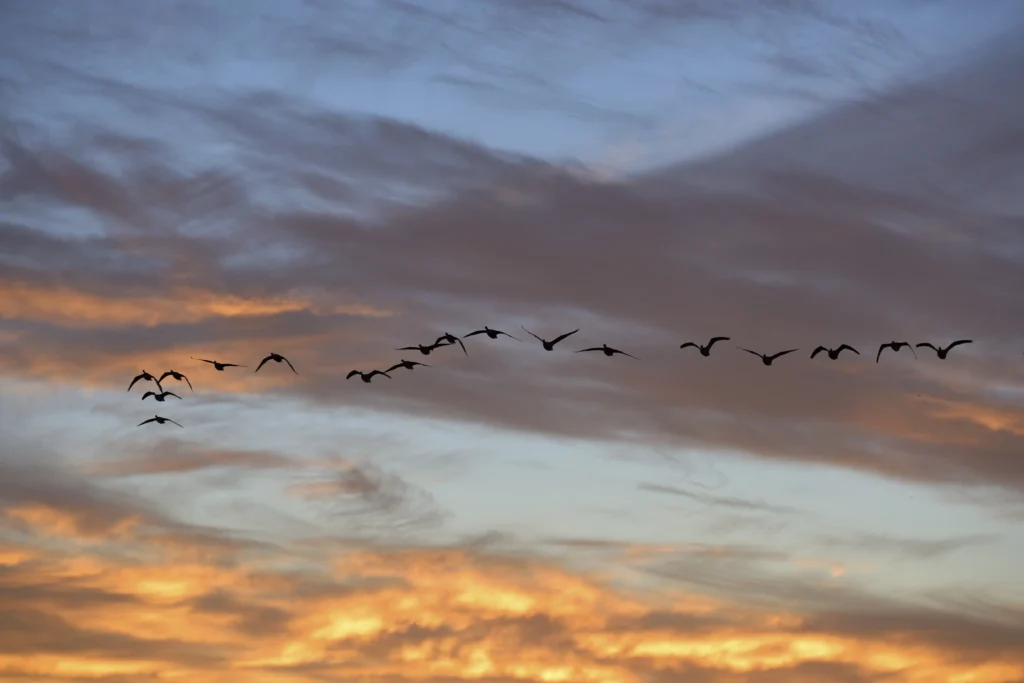
Here in deepest Breckland, with our (relatively!) dry climate, it is easy to forget how important the UK is for wintering waterbirds. However, millions of ducks, geese and swans migrate to our shores every winter to escape colder conditions in their breeding ranges. Some species fly more than 600 miles over the North Atlantic from their breeding grounds in Iceland. The Pink-footed Goose, the grey goose species that is synonymous with the North Norfolk coast in winter, and the Whooper Swan, a yellow-billed swan that’s a familiar sight in the Fens, both fall into this category.
A wider range of waterbird species come from a northeasterly direction: Scandinavia, elsewhere in northern Europe, and eastern Russia. Most local waterbodies are quite small, but even relatively modest-sized ones such as the British Trust for Ornithology (BTO)’s Nunnery Lakes reserve see an increase in numbers of some species. For example, Tufted Duck counts can reach up to 100 individuals in some winters. These black and white diving ducks, the males bearing long head feathers from which the bird gets its name, do breed here, but numbers swell noticeably in winter. These distinctive ducks can usually be seen from the network of permissive paths around the lakes or from the viewing platform.
Teal, a small duck that filter-feeds in shallow water, is another whose numbers can exceed 50 at the Nunnery Lakes in winter, though they are less conspicuous as they often hide in waterside vegetation on the west side of the reserve. This area is best viewed from the screen on Barnhamcross Common, just south of the Anglian Water pumping station.

It is harder to predict the occurrence of various other winter-visiting waterbirds. One such species is White-fronted Goose, a smallish grey goose with a white ‘blaze’ above its beak, which has two distinct populations, one in northern Canada, Alaska and Greenland (‘Greenland White-fronted Goose’) and the other in Arctic Russia (‘Russian White-fronted Goose’).
Variable numbers of the Russian birds journey to East Anglia each winter. Numbers have been falling during recent decades as milder winters are reducing the amount of snow and ice on the Continent, giving these birds less incentive to cross the North Sea. Single birds or small family groups occasionally appear with the much more numerous Greylag and Canada Geese at the Nunnery Lakes, and sharp-eyed BTO staff were pleased to pick out two that dropped in for a couple of brief visits either side of the New Year.
To learn more about the birds and other wildlife on the reserve and plan your visit, go to:
www.bto.org/about-bto/nunnery-lakes-reserve-friends
– Nick Moran


