

Thetford Town Council have paid a special tribute to local veteran Ronald Butcher, who passed away earlier this year, during this year’s Remembrance Day Parade and Service on Sunday 9th November.

Ron Butcher – In their Glorious Company Portraits of British Second World War Veterans ©Robin Savage
As part of a Town Council project commemorating the 80th anniversaries of VE Day and VJ Day, Ronald shared his story in an interview. During the preparation for this recording, he recited both the Exhortation and the Kohima Epitaph. These were played as part of the service as a special tribute.
“Dad was a proud Thetfordian and achieved so much for the town as well as his service for his country,” said Christine Lincoln, one of Ronald’s daughters. “We have been touched by people’s response to his death. He was our hero and was so well liked by all he met.”
‘When You Go Home, Tell Them Of Us And Say,
For Your Tomorrow, We Gave Our Today.’
Born in 1926 in St Mary’s Crescent, Ron was the youngest child of Ted and Nellie Butcher. Ron attended Norwich Road School, but his education ended abruptly at thirteen when he left to work on the family’s smallholding and help the Forestry Commission during the war. Ron joined the local Home Guard in Thetford alongside his father. He was trained to handle firearms and recognise enemy aircraft, and helped build coastal defences, as well as assisting his uncle, a trawlerman, in sweeping for mines off Lowestoft. Ron was lowered over the side of a trawler with a rope around his middle and a spanner tied to his wrist, removing nodules from unexploded mines. During this time, Ron worked as a delivery boy for International Stores, where he met Grace, the woman he would later marry.
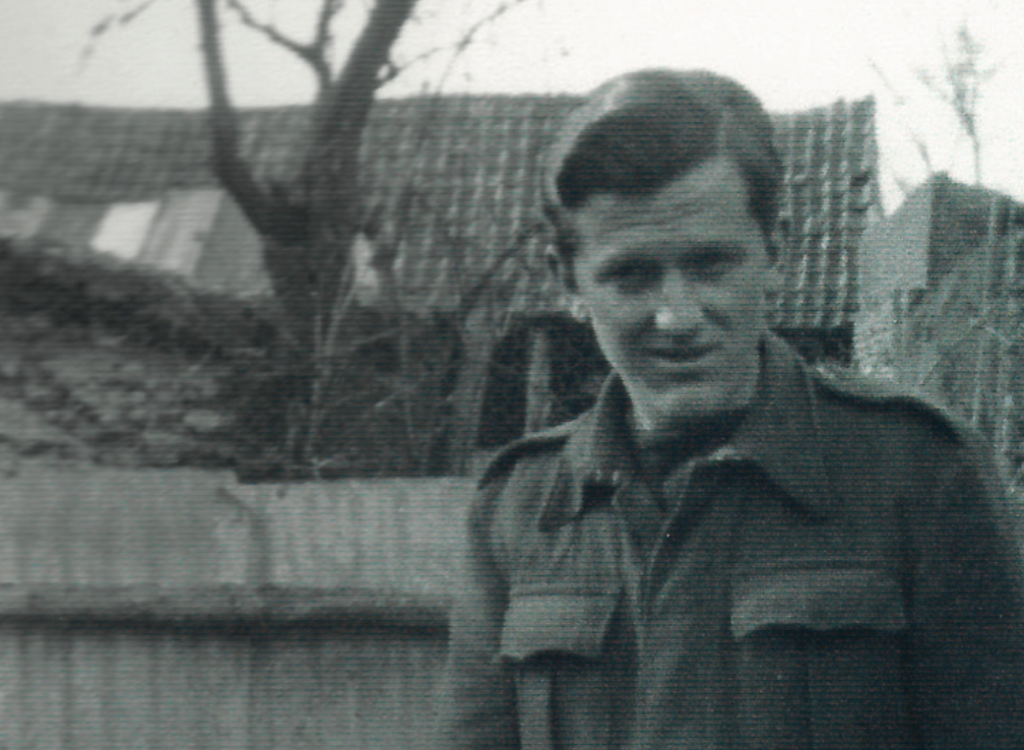
At just 15, Ron was determined not to be conscripted into coal mining as a “Bevin Boy.” He persuaded his mother to sign his enlistment papers and left for Norwich with a group of friends, including Des Harvey and Robert Regent, and joined the Merchant Navy. In early 1942, after five weeks of training and a week’s leave, he reported to London’s Royal Docks and joined his first ship, transporting supplies along the East Coast. During one of these early voyages, his ship was torpedoed. Ron spent three hours in freezing water surrounded by burning oil and the cries of drowning shipmates. Long before PTSD was recognised, Ron frequently woke from nightmares, reliving those harrowing moments.
Following three weeks of recovery, Ron joined the Atlantic convoys as gunner and radio operator. He faced constant danger from German U-boats and remembered hearing enemy voices on the ship’s radio when submarines were nearby. His ship transported crucial cargo, including aircraft engines, anti-aircraft guns, grain, vehicles, and even a U.S. locomotive on one occasion.
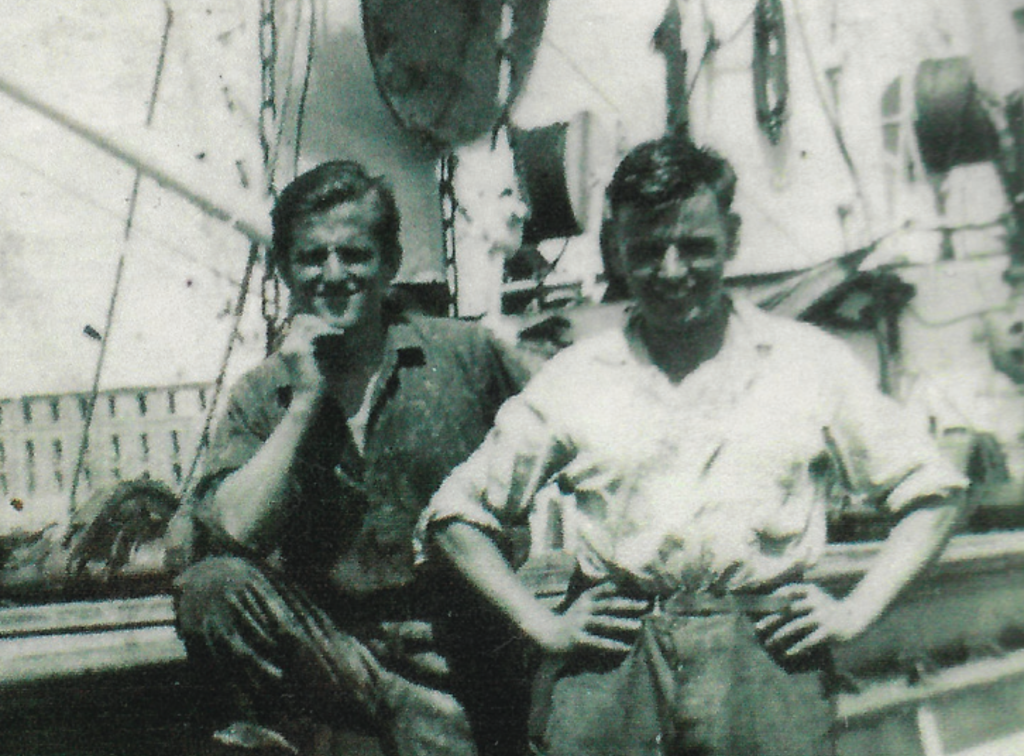
In the lead-up to D-Day in 1944, Ron was assigned to the U.S. Liberty Ship Francis C. Harrington, which carried over 500 Allied troops and their equipment to Juno Beach. On D-Day +1, the ship struck two mines off Omaha Beach and became a sitting target. Under heavy fire, the crew patched the hull with canvas and mattresses and continued unloading troops and equipment for five days. Ron described it as “hell on earth”: smoke blackened the skies, and the air rang with explosions, gunfire, and screams. The noise caused permanent hearing damage in his right ear. Amidst the chaos, Ron spotted his old friend Des Harvey and managed to shout across to him — a fleeting moment of joy in the midst of battle. Later, Ron was reassigned to another ship and returned to the Normandy coast to support the advancing troops, assisting chaplains in recovering bodies from the sea for burial.
Ron continued serving after D-Day, sailing to Malta and across the Atlantic. One of his more joyful wartime memories came from Naples, where he heard the great opera singer Beniamino Gigli perform — sparking a lifelong love of opera. Ron was on an Atlantic convoy on VE Day — due to maintaining vigilance in hostile waters, he didn’t learn of the end of the war until two weeks later.
After the war, Ron remained at sea for a time, transporting oil from South America and joining whaling expeditions, though he admitted he detested the latter. In 1951, he returned to Thetford, married Grace and later took a job at RAF Lakenheath, where he occasionally brushed shoulders with notable figures like Roosevelt, Eisenhower, and Churchill. He became an active member of the Royal British Legion, helping raise funds for veterans, including those in need of prosthetic limbs.

In the early 1980s, Ron accepted a post as Quartermaster at Colchester Garrison. On his retirement, he was honoured with the Imperial Service Medal, presented by Queen Elizabeth II, in recognition of 30 years of dedicated service.
Ron remained active with the Royal British Legion and was proud to be President of the Thetford branch until 2012. With Grace, he organised Poppy Day collections for many years. Each year at the Remembrance Service, Ron would read the roll call, his voice often catching when he reached the name of his friend, Robert Regent. He was a member of the Normandy Veterans Association and once appeared as an extra in Dad’s Army.
Ron enjoyed the D-Day 80 commemorations, speaking modestly but proudly about his service. Earlier this year, Ron accepted an invitation to the 80th Anniversary of the Liberation of the Netherlands in May with the Taxi Charity for Military Veterans. Ron was surprised by the interest in his story. He enjoyed his trip and agreed to travel to Normandy for the D-Day commemorations. Ron found Normandy more solemn, and the memories were harder to bear, triggering the nightmares he once suffered from.

Ron’s last trip was to the Battle of Britain Service in Norwich on 12th September. He died peacefully at home, surrounded by family, a few days later. A guard of honour attended Ron’s funeral in early October. A life remembered with gratitude.

Promoted content – Please mention the About Thetford website when responding to advertisements


